Mostrando postagens com marcador votoms. Mostrar todas as postagens

domingo, 20 de maio de 2018

VOTOMS: Lightning Slash (Playstation 1)

Original title: 装甲騎兵ボトムズ ライトニングスラッシュ
Release date: March 18, 1999

This AT here is the Slash Dog.
The final PSX VOTOMS game, Lightning Slash is the best of the bunch. Taking cues from Berserga Monogatari and forsaking everything about Uoodo-Kummen, this game expands on everything good that Berserga had. The main gameplay venue here is the sport of Battling. There is a story mode, which is structured just like Berserga's too - choose options, talk to people, arrange Battling matches, and so on. Other modes are Battling, Versus and Survival.


Anyway, for the story mode. The story here is that you're a Gilgamesh AT pilot called Erslight/Eslight Vicks (you can change his first name), disillusioned with the world because something that happened in his past. He was part of the Hamilton Platoon, which was wiped out by its own commander, a woman called Tia Hamilton. This incident was quite fishy to begin with, and when the Hamilton Platoon's existence was officially erased to cover it up, our hero left the army and went to the city of Woodo. There, he met Robe, a matchmaker (someone who arranges Battling matches) who introduced him to the world of Battling. Through the game, you'll meet old friends, and by gaining notoriety in the arenas, you'll finally discover the secret behind the destruction of the Hamilton Platoon. As in Koutetsu no Gunzei, this game also has a totally original story. No characters from the TV series appear here, except for a single cameo: Keak Carradine, a character from Armor Hunter Mellowlink. If you saw Mellowlink, you'll recognize that Carradine is an investigator for the Melkian Army. In this game, he's investigating a project called Facial Soldier, which seemingly aims to duplicate  the powers of a Perfect Soldier.

Story Mode sequences.
As for the gameplay itself, the game uses a different engine from Berserga, so it doesn't feel the same. While Berserga was a Virtual On clone, this game doesn't really feel like anything else I've played in the past. The controls take some time to get used to, but they get the job done. The only problem is that left/right is reversed when the AT is dashing backwards - this is a little disorienting at first. There is no "hard" lock-on, like in Berserga. You do lock onto the enemy when you press the attack buttons, but you're not "anchored" to the enemy. If that sounded too complicated, let's just say that Berserga used Z-Targetting, like Zelda Ocarina of Time or Megaman Legends. Once you locked onto an enemy, the directional buttons moved your character around the enemy, kinda like you're anchored to them. Not in Lightning Slash. When you push the attack buttons (square and circle by default), the AT turns towards the enemy to attack, but you can still move freely.


The game doesn't really help you get acclimated to the controls... it throws you into a battle right at the start, and there's no training mode anywhere. Still, since you only lose your betting money if you lose, a loss isn't really that costly.

Shop screen. Pictured is the Berserga WP.
Anyway, you have 5 attack options in total: both arms, both shoulders and a bomb item. When you begin the game, you can only use your arms, and only use a gun on the right arm. The left arm will do arm punches. Shoulder weapons and bombs only become available once you progress enough in the game. Ammo for hand-held weapons is mostly infinite, although there's a counter onscreen showing how many bullets are left in your current magazine. Once the magazine is empty, it takes an instant to put another one in. Ammo for shoulder weapons and bombs is definitely not infinite. The counter for shoulder weapons only shows up when you're holding R1 (otherwise, the handheld ammo counter is always shown), while bombs are shown at the top-right of the screen, below your lifebar.

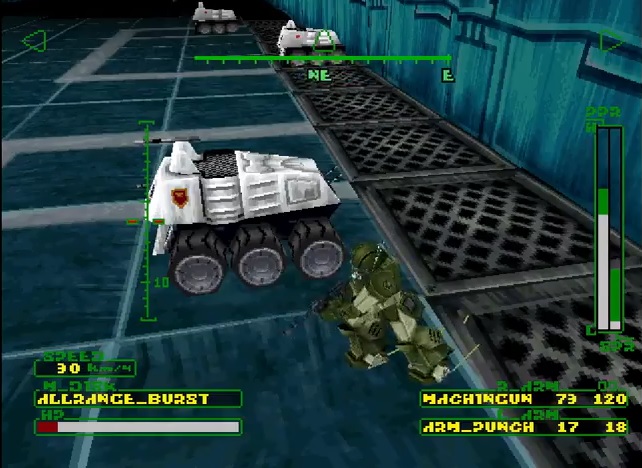
Fighting a missile launcher vehicle.
Instead of a single health bar, every AT (player or enemy) has two: ATHP and PTHP. ATHP is what you've already guessed, while PTHP is Polymer ring HP, the liquid that gives ATs their human-like movements. If either of those bars is depleted, the AT is destroyed. At the beginning, most weapons will damage ATHP much faster than PTHP, but there actually are weapons that damage PTHP faster than HP - those are situational weapons like flamethrowers.

When you connect a punch at short distance, the camera angle changes.
Combat is done at two distances: "In Fight", which is short range, and medium/long range. When you're in "In Fight", a small window appears at the bottom of the screen, meaning you're into this mode. What this does is change a few of your attacks: if you're carrying an assault rifle and try to fire it while at this distance, you'll try to smack the opponent with it instead of firing. The only advantage I can see of this mode is that, if you attack an opponent with an arm punch, you can sort of lock them in place (like a throw in a fighting game). The camera will change when you do this. Speaking of throws, the ATs can also do a throw with the triangle button. It's sort of a desperate maneuver, since it leaves you open to everything and is quite slow too. The advantage of the throw is that the damage done to PTHP is huge, and the enemy is left sprawling on the ground for a few seconds. You can't shoot the enemy on the ground, but you can get away from him.

Fighting a Brutish Dog.
As for boosting/roller-skating, the system is much better than in Uoodo-Kummen. Although you still have a skating bar, it's pretty big, and you can usually skate through the whole arena in a straight line before it empties. One thing of note is that the skating isn't free-form like in the PS2 game. The way you initiate the skating will change the movements you can do. You can either skate forwards/backwards, or to the sides (strafing). If you're skating forwards, you can't just start strafing while doing it. You have to stop and then start strafing. You can also circle around an enemy by inputting different directions while already skating. Example: if you're skating forwards, you can circle around the enemy by pressing left or right. If you're strafing, you can circle around by pressing up or down.
Even without skating, your AT can move pretty well too. Walking isn't all that fast, but at least it's not as slow as molasses like in Uoodo-Kummen. If you hold L2, you can also walk to the sides. This is mostly for emergency situations.

Slash Dog fighting.
The ATs can take damage on their limbs and weapons too. If you get attacked too much on the right side, for example, the AT may lose its right-side weapon (each weapon has its own armor points), and that arm becomes useless (even for arm punches). The arms themselves can be destroyed too, and in that case the AT attacks with its legs. It's kind of a sad sight seeing your AT with both arms blown off, trying to kick the enemy to death.

Customization screen. Pictured is the Slash Dog.
For the customization aspect. You start the game with a Scopedog, and there's already a hangar at the beginning ("Factory" option) to customize stuff. The options are:
- Change parts: change parts of the AT. Available parts are Head, Right Arm, Left Arm, Body, Legs, Backpack, Muscle Cylinder and Turbo.
- Change weapons: Right Arm, Left Arm, Right Shoulder, Left Shoulder, Bomb.
- Color: change the colors of your AT. Can change the whole AT at once, or only parts of it. Can also choose color profiles from other ATs, like Bloodsuckers, Bersergas, Purple Bears and so on.
- Emblem: can paint an emblem over a specific part of an AT. You can either apply a pre-made emblem or make one yourself.
- Hangar: change the whole AT.
- Name: you can change the name of your AT and your ringname. Those names appear right before a battle.
- View: just rotate the AT around to check it out.

Matchmaking screen.
To customize your AT with parts, your only option is to buy them with the money you get from the fights. At the shop, you have three options:
- ALL AT: Buy a whole AT. Note that a whole AT costs much more than anything else.
- Arms: Buy weapons.
- Parts: Buy parts.

The final customization option only appears once you reach the second chapter. There's another shop called "Junk" where you can customize parts or weapons with better attributes.

Now for the story mode. You usually get 4 options onscreen during the game.
- Bar: talk to people, arrange fights.
- Shop: buy stuff.
- Factory: customize ATs.
- Save: self-explanatory.

Story Mode main screen.
The parts all have their pros and cons, like in Armored Core. A better part will usually be heavier too. A better arm will not punch as hard as the first available arm, and so on. Weight is important because you need to stay mobile. Like in Armored Core, you need the right balance between speed, defense and attack power. Different ATs also have different attack paradigms: the Zwergs for example, can't attack with melee, since they fire from their arms. If you put a Brutishdog arm on your Scopedog, it won't be able to punch with that arm.

Shop screen.
There's also a separate statistic, the Mission Disk. It's sort of like your level in an RPG. The mission disk is that same between every AT, and you get experience on it by battling and defeating opponents.  The mission disk gives you passive stat increases, which you can see on its appropriate screen. All in all, Lightning Slash has a pretty good customization system. Too bad there's nowhere to test it without penalties, like in Armored Core. Well, nothing's perfect.

The story progression is a little different from the norm. You can't just go to a place and talk to people to go ahead with the story, like in Berserga. Specially in the beginning, you have to fight a few battles at the arena before the story moves forward. In the meanwhile, you really have to fight in Battling. This part is pretty self-explanatory. Choose an opponent, choose the kind of fight, bet and fight. There are 4 kinds of fights: 1 vs 1, 1 vs 2, 2 vs 1 and 2 vs 2. 1 vs 1 is the norm. In 1 vs 2, you fight alone against two ATs. You get a pretty sizable bonus compared to 1 vs 1. In 2 vs 1, you choose a partner and fight against 1 AT. The prize is slashed in half (the other half goes to your partner), so you actually get less than in 1 vs 1. In 2 vs 2, you choose a partner and fight 2 opponents. The prize is the same as in 1 vs 1. You may want to set up a few 2 vs 2 fights along the way, because you can actually get to know people through them.


While in Battling, you'll also see that enemies have different classes. You start at class D4, and can fight enemies from D4 to C2, for example. The difference here is that enemies at higher classes are better equipped and pay better. One nice touch here is that you can take a sort of "admission test" to move up classes. You pay a fee and the matchmaker will tell you to fight a number of opponents. If you win this fight, you go up a class. Easy, right? Well, not really. Every class is already accessible from the beginning, but the higher ones have such a difficult admission test that you'll need to wait until you have better weapons to try them. The classes are D4, D3, D2, D1, C3, C2, C1, B2, B1, A and S. To put it into perspective: to change from D4 to D3 you fight one opponent. To change from B1 to A, you have to fight 10 opponents, back to back. To change from A to S, you need to defeat 15 opponents! FIFTEEN opponents. This is harder than the final boss. Anyway, what changes when YOU get to a better class is that your payments are better, and your partners are better-equipped too.

One little tidbit about the arena fights: you can actually fight against vehicles, like helicopters, launcher cars, hovercrafts and even tanks! I wonder who in the VOTOMS world would be crazy enough to fight in Battling against an AT... with an helicopter. Pretty nice commitment to variety from the developers.

Tanen gives you the Slash Dog.
Back to the story mode. You usually have three people to talk to: Robe (your matchmaker), Pamela (assistant) and Tanen (an AT mechanic). When moving the story forward, you'll usually get a message from Robe asking you to do something for him, or that something happened and you need to get right into it. The first situation of the sort happens when Pam is kidnapped. Robe will stop arranging matches until you sort this situation out. An option called "Colosseum" or "Mission" will appear on the main screen, and when you choose it, you go into a story battle. They're not much different from a Battling match, they just have either more opponents or are fought outside of the Battling arena. Sadly, there's not much variety to those story missions. If you were expecting some missions akin to the PS2 game's... well, you won't have them. There's no objective besides "destroy everything". Rarely you'll get an "escape" objective too. If you've ever played Virtual On MARZ, then you already know the sort of missions I'm talking about. You're always in "Battling Mode", there's no separate mode for missions.

Chapter End movie.
Anyway, by fighting in matches and either winning or losing, you move the story forward a tiny bit at a time. The amount of matches that need to be fought change based on what the next story event is, but you'll always be warned of the story event. You'll get a choice, and the cursor will always be at the bottom choice, which is usually "I need to get ready first". If you don't read japanese, well, that's your cue when a story mission comes up. That and the matchmaker won't arrange matches until you complete the mission.


The story is divided into 4 chapters, each one taking place in a different planet. You start in the city of Woodo, and later move onto other planets. To signify that a chapter ended, there'll be a scrolling video with text over it. You only unlock more options in the shop on Chapter 2, where you'll be spending most of your time in the game. On Chapter 3, you stop getting Battling matches (there's no Battling arena), and now must do missions for Robe. The missions are usually fights against multiple opponents. One thing I noticed is that the environments you fight in also start becoming more diverse from Chapter 2 onwards. Before, you were always fighting in the same arena, even during missions. After, you'll fight inside craters, cages, rugged terrain and that kind of stuff. You can also fight when it's raining or snowing (the AT slips more than normal). It took me a while to notice that you fight during different times of the day too (the background sky changes). To see the conditions you'll be fighting on, look at the two icons on the screen where you arrange a match: they tell you the conditions.

Tia Hamilton while being pursued.
Tia Hamilton after battle.
If you want to know how the story concludes, let me tell you. The Facial Soldier project aimed to mass-produce soldiers that had the same abilities of a Perfect Soldier, but at a fraction of the cost. Remember that PSs needed copious amounts of Jijirium to function (Jijirium is a costly commodity in the VOTOMS universe). Anyway, what this project did was implant a Nerve Connector into the medula of the AT pilots of the Hamilton Platoon (your character included), to enhance their abilities. However, the implants are prone to malfunctioning, and the soldier will go berserk as a result. That's what happened to Tia Hamilton. There's no way to remove the Nerve Connector without killing the person. By the end, most of the candidates were disposed off.

Keak Carradine, from Armor Hunter Mellowlink.
You fight Tia Hamilton in a last desperate battle at the end of Chapter 3, with Gyap (a friend of yours from the Hamilton Squad) as your partner. This battle was awesome for me because Tia piloted the Gusty Dog, the main AT from Battling Road (the SNES game). After the battle, Tia Hamilton dies and you finally get closure on the demise of the Hamilton Platoon. Some ATs appear right after it, and Gyap is seemingly killed. You're then pursued by the Secret Society (yeah, the same guys from the anime),  battling scores of ATs (I think you can just lose to expedite the process...?) and they force you onto a shuttle towards another planet. Thus starts the final chapter, Chapter 4. On the way there, you'll meet Keak Carradine, a Melkian Army investigator (same guy from Mellowlink), who'll disclose all he knows about the Facial Soldier project. You'll then be taken to a series of battles, where you'll fight against some of your past partners from Battling. After some fights, it's revealed that Gyap wasn't killed, and was just kept under control by an envoy from the Secret Society, named Togal. However, it later becomes apparent that Gyap isn't really being controlled at all, but he still wants to fight you. He unveils the final AT, the Trial Gorilla, and the final battle begins. Once you defeat him, that's the end. The Facial Soldier project failed (even if you survived) and the Gilgamesh-Baralant conflict is still going on.

Well, I think that's mostly it for the game itself.

Final boss, the Trial Gorilla. Explosions!
AT variety is one thing that surprised me. I always played a lot of Gundam games, and MSVs (Mobile Suit Variations) are rare in those games. Usually you only get an MSV or two per game. Three if you're lucky. For example: in Gundam Encounters in Space, you get Gundam Units 4 and 5.  In the VOTOMS games, you actually get quite a few original ATs. Anyway, there's a lot of ATs here, and a few that never appeared in the TV series. The titular AT of the game is a Scopedog variation called Slash Dog. It's the red AT on the cover, and also in the intro FMV. You get it way into chapter 2. After playing Battling Road for the SNES, I was kinda surprised when I learned that one of your opponents uses the Gusty Dog, the titular AT from that game. The final boss uses another original AT called Trial Gorilla, which is sorta like an "AT heavy weapons platform", in that it uses even beam weapons! For those that don't know, beam weapons are very rare in VOTOMS.

It doesn't make much sense to have all those ATs by this point in the story (I believe Lightning Slash is set either a few months before or during the TV series), but I guess they just wanted the fanservice. There's a passing mention of Neeva (the antagonist of Big Battle), and you fight someone else on his AT, the Ecrevisse. At least this one makes some sense, since there's an Ecrevisse in Dead Ash too, I think.

As for the other game modes, there are Battling, VS and Survival. Battling and VS are the same mode, but Battling is against the CPU, and VS is for two players. The ATs you unlocked during Story Mode also appear in Battling Mode, if you load that save beforehand. You can even fight as the vehicles, which is pretty fun. You can also bring in the custom AT from Story Mode.

Battling Mode selection screen. I think the two empty spaces at the bottom are the missile launcher vehicle and the tank.
This was a game that surprised me in a lot of ways. Most of them positive. The story isn't just some derivative crap, there's some real thought put into it. Too bad you have to take the story mode on such small doses. If you're a fan of VOTOMS and have access to a clear save game, I'd say try to put a few hours into the game, even if only in Battling mode. You won't regret it.


Can I play this without knowing japanese?
Yes, but you'll miss out on a ton of stuff. If you really want to brute-force through story mode, just know that:
1) when you arrange a match, the bottom option is always yes, and the top is no. You have to answer YES twice to enter a match.
2) when you arrange a mission (not story mission), ditto.
3) when you're faced with a mission choice in story mode, the top choice is always YES and the bottom one is always NO (or "I want to prepare first").
4) you have until the end of Chapter 3 to buy stuff. Don't worry, it takes quite a long time to reach that point. Just know that there are no shops in Chapter 4.
Still, there are a few choices where you'll need to know which one is YES and which one is NO. You don't lose a lot by choosing the "wrong" choice, just some extra battles.

segunda-feira, 14 de maio de 2018

VOTOMS: The Battling Road (Super NES)

Original title: 装甲騎兵ボトムズ ザ・バトリングロード
Release date: October 29, 1993


The only VOTOMS game for the Super NES, VOTOMS: The Battling Road uses Mode 7 effects (think Mario Kart). It's an action game with a third-person view of your AT, with two modes of gameplay: free roam, where you play inside an arena against opponents, and on-rails, where you must dodge and destroy enemies on a linear path, fighting a boss at the end. You play as a Battling pilot called Famin/Fa Ming, an engineer whose parents have been killed in an incident. He uses Battling (a sport in VOTOMS, where people fight with ATs) as a way to have his revenge. The story is told through cutscenes between stages. The game is 8 stages long, and you have 3 continues. Don't worry about a game over, since if you lose all your continues, the game gives you a password.


Now for the gameplay. The controls are rather simple. Up moves the AT forward, down reverses it. Left and right "nudge" the AT to the sides, but only when it's already moving. By itself, they do nothing. Y and X fire your equipped weapon, B and A change the equipped weapon. L and R use the AT's turnpick to turn the AT towards that direction. That didn't make a lot of sense... it's like this: the ATs in VOTOMS have a stake in each leg, called a turnpick. When the AT needs to do a quick turn, this stake slams into the ground, holding the AT in place, while it turns around.
Lastly, push SELECT to see the enemies' health. This isn't mentioned anywhere in the controls, but it sure makes your life a lot easier.


This game is rather short. Being only 8 stages long, you can probably complete it in under 2 hours. Almost all of the stages are Free Roam, with only two of them being on-rails. There's a cutscene after every stage. They're pretty well drawn for a SNES game, although there's some repetition. A pretty good job, all in all.


There's not much variation of ATs in the game, sadly. You play most of the time with a Scopedog, with minor alterations. The first version only has a punch, the second version has the assault rifle, and the final version, the Turbo Custom, has an assault rifle and a rocket launcher. In the two last stages, you'll get a Gusty Dog. I don't remember this one appearing in the anime, so I guess it's exclusive to this game. The enemies also don't show much variation. You fight against Scopedogs (assault rifle and rocket launcher variations), Standing Tortoises and a few exclusive bosses. The first boss is a tank with a giant Scopedog scope, and the final boss is an exclusive too. At least something new for the fans.

Famin's final mech, the Gusty Dog.

Final boss. The grey shell on top is another layer of armor. Once you destroy it, the real AT comes out.

However, as is the fate of almost all of the VOTOMS games, the controls really suck. The little nudge your AT does when you push left or right isn't enough for good turning. You'll have to push L or R to turn in that direction, but that stops the AT on its tracks. So you'll have to do lots of little corrections while pursuing enemies.


My main problem with this game is balance. I guess either they didn't bother to test it throughly, or were inexperienced developers at the time. First, the weapons: you can get three of them in total. An arm punch, an assault rifle and rockets. The first two have infinite uses, while the rockets have different ammo counts depending on your mech: the Scopedog Turbo Custom has 10 rockets, while the Gusty Dog has 15. The first problem with the weapons is that the assault rifle is really useless. It sprays bullets all over the place, the bullets don't go very far, and the damage is very, very small. And this isn't just on your side: the enemies' bullets are also very weak. This leaves us with the arm punch, which is too strong for its own good. Once you realize its power, the game becomes much easier. While you need 10~12 seconds of connecting bullets to down a single enemy AT, you can do the same with 5 to 10 punches. And since the enemies' bullets are as weak as yours, rushing them and punching them to death becomes a very viable tactic, all the way to the end of the game. I'm not kidding: you can just run up to the enemy and punch it 5 times, all the while getting peppered with bullets, and not lose even 1/10 of your health bar. The enemies have as much trouble hitting with bullets as you do. Huge win...?


The other problem with balance is in enemy AI. It's very easy to exploit. See, the enemy moves just like you. It needs to use the turnpick to turn around. However, the AI doesn't know how to do a quick turn while in place (up+L, down+R, vice-versa), and this will lead to the biggest exploit. The AI has something I call "pursuit mode". When you accelerate towards the enemy while they have their back turned to you, they'll try to out-turn you, all the while accelerating forward, because as I said before, the AI doesn't know to quick turn in place. If you keep pursuing the enemy's back, it'll keep failing to out-turn you, because you can turn faster than them. This'll make almost every fight a game of "grab the chicken". And since the enemy only attacks if you're completely in front of them, they'll very rarely attack you. Just don't let them face you, and you'll almost never get shot at. This could be a problem in stages against multiple opponents (you can face up to 3 at once), but I realized the enemies only pursue you if you're inside a certain radius around them. If you keep pursuing a single enemy and keep away from the others, they won't bother you.


The reason I believe this game wasn't thoroughly tested is because sometimes you'll see enemies shooting at each other. It happens all the time. I looked for a reason in the story (such as a Battling battle royale), but this happens in every stage with more than 1 enemy. It's cool that the enemies can hit each other - but this is not just a case of friendly fire. You can be half a stage away from them and see two ATs shooting each other to death. So I think it's an AI issue, and not done on purpose.


Yet another issue with the AI is that it doesn't seem to know where it's moving towards. Some stages have mines on the ground, and the enemy will trigger them without a care in the world. They'll also hit the stage walls and try to futilely turn to the side, and just hit another wall. The only thing the AI seems to know how to do well is shoot you when you're in front of them.

I said balance is a problem, but at least in this game, the balance is totally skewered towards you. Thus the game is too easy once you realize how you can exploit it. And you don't even need to look for ways to exploit it - this just happens naturally as you play the game. Usually game balance is against the player, but in this game, it being good to the player just makes everything too easy.

One last thing with balance is that, while some enemies have rockets too, they're finite, just like yours. So if you're having problems with those yellow Scopedogs, you can just try to run circles around them while they waste all their rockets. Then hit them back with impunity. It seems enemies can't do arm punches in this game. At least I've never seen it.

The game also has a 2 player mode, which can be rather fun. There's no option to play against the CPU, just against another player. The modes are:
- Death Match: you against another player.
- Battle Royale: same, but with CPU-controlled opponents too.
- Panel Battle: you have to pass over colored panels on the ground. Each color gives a certain ammount of points. Whoever scores most points in 3 minutes wins. You can also kill your opponent, but both of you only have arm punches, and they're much weaker compared to the Story Mode version of the weapon.

For Death Match and Battle Royale, you can select your mech and also its colors. There are only four mechs: Scopedog (arm punch), Scopedog (assault rifle), Scopedog (Turbo Custom) and Standing Tortoise. It looks like you can't choose the Gusty Dog or the Scallops (final boss) here.

In the end, as is the fate of most VOTOMS games, this isn't something you'll spend a lot of time on. But play it at least once and see for yourself.

If you're looking to get a little more out of this game, look at the Cheats page on GameFAQs. There's a lot of good stuff there.

sexta-feira, 4 de maio de 2018

VOTOMS: Black Unicorn (PC-8801mk2)

Original Title: 装甲騎兵ボトムズ ブラック・ユニコーン
Release date: December 8, 1988
Cover
The first VOTOMS game, and it has proved to be quite elusive to find, so I've never played it. From what I gathered, it's a side-scroller with simulation elements. This is a notoriously hard PC-88 image to find, even the archive.org sets don't feature this game at all. You play as a squad that has to defeat a group of 4 pilots called Black Unicorn.

A page presenting the game, with some screens.
The 2 games at the bottom are MS Field: Kidou Senshi Gundam and Muteki Keiji Daidageki, both for the PC-88.

Intro

One of the two modes of play: top-down view. There's also a side-scrolling mode.
The antagonists, the Black Unicorn Squad. They all use Bersergas.
The emulator screenshots are from the blog pages below:

quinta-feira, 3 de maio de 2018

VOTOMS: Uoodo-Kumen Hen (Playstation 1)

Original Title: 装甲騎兵ボトムズ ウド・クメン編
Release date: April 2, 1998

Cover

Oh boy, this one. This is the first game where you play as Chirico, and it's all over the place. It's an action game where you control the title character through 10 stages of non-stop action. And frustration. See, this game is too hard for its own good. The movement is seriously borked - your AT moves slow as molasses, but that's not the worst. The main venue of movement of ATs was always roller skating along the ground, but this option is very, very limited in this game. To the point of being almost unusable. Ok, there are two bars present at all times on your HUD: they control the ammount of Polymer Ring fluid that's distributed between the roller skates and your AT's other systems. There are 5 configurations: 10% SYS, 90% Skates, 25% SYS, 75% Skates, 50/50, and the other way around. The Systems part controls your recoil (every time you fire you deplete it a little), and the Skates part controls your skating and also leg movement (limited). The bars replenish over time, but it's so slow that you'll have to stop completely and watch them refill. They also refill while you're walking, but it's much slower than when you're fully stopped.

The other thing? The aiming controls. They're completely manual. There's no lock-on (at first) in this game. So you have to shoot in front of you hoping you'll hit the enemy. While you're trying to dodge THEIR attacks. And this is where the system grinds to a halt. You can do a ton of cool maneuvers with this limited system, but you can skate for so little time that it has almost no use at all. Even the AI has problems trying to aim at you.
Compounding those problems, there is another: length. The game is short, only 10 missions long, BUT the missions themselves can be very long, just because you have to go through them very slowly. See, your mech can get destroyed very quickly (it's an AT, after all), but the enemies can also take a lot of punishment before going down, even the grunts. A police AP, which is just a glorified car, takes up to 6 seconds of non-stop machinegun fire to bring down. And you have to fire at it while strafing (very slowly), because it will fire back at you, and kill you pretty fast. The enemies don't have many variations, being mainly cops (yeah, on foot), cops on bikes or flying cars, APs, helicopters, turrets and other ATs. ATs are pretty rare in this game, probably 5% of the enemies are ATs.


One way you can exploit the system is by firing while strafing to your right. See, most of the APs and ATs fire with their right side, so by strafing to your right, you can hit them consistently and also dodge their fire. However, this doesn't work against boss ATs. There are very few of them, but trust me when I say they'll shred you so fast they'll make you cry. The best strategy I could come up with was to rush them and try to punch them (there's an Arm Punch) many times, and pray they didn't try to strafe away from me. It worked pretty well, and you'll see it's probably how everyone defeats the final boss.


Ah, the Arm Punch. It's a very strong weapon, but because you need to get up in the enemy's face, and your AT also stops a little when firing it, it's useless against almost everything you fight. Even the APs will try to back up when they see you close by, making the arm punch useless.


For all its failures, I guess the biggest one is the aiming system. There's no lock-on, but even then, you'll see that your shots are going through the enemy, not really hitting anything. This happens mostly against cops on foot - you can see your shots going through them, and the only way to connect is to get closer. Other times, you're shooting around corners (a valid tactic), but the game doesn't give you any indication that the shots are being stopped by an invisible wall (sometimes you see a small spark, but not always).

Because you're playing as Chirico, you can only use the Scopedog. The very basic one, with a machinegun and an arm punch. You can play as the Red Shoulder Custom (it has many weapons) during two stages, but that's it.

All in all, stay away from this one. Below is some gameplay I've recorded off it:


How do I get auto lock-on?
You need to finish the game once to get an item that enables it. There's a save game on GameFAQs:
https://gamefaqs.gamespot.com/ps/573558-soukou-kihei-votoms-uoodo-kummen-hen/saves

Can you play this without knowing japanese?
There is some narration between the stages, and a few missions have a failure condition, but nothing you can't discover through some trial and error.

quarta-feira, 2 de maio de 2018

VOTOMS: Koutetsu no Gunzei (Playstation 1)

Original Title: 装甲騎兵ボトムズ 鋼鉄の軍勢
Release date: September 30, 1999

Cover

Koutetsu no Gunzei (tl: Steel Force) is an SRPG. You can say it's sort of a Front Mission 3 clone, missing some features. It's the only SRPG of the VOTOMS games, and although it has an interesting setting, the game itself seems to be actively trying to make you stop playing it, some times.


About the story: what I gathered from it is that you play as Maxwell, a member of the Gilgamesh army, who was sent with his squad to a planet called Magdalena. Magdalena was under attack by Baralant forces, and your first mission was to fight through the siege. One thing of note is that the story is told through 4 chapters, and there is a timeskip between each. In the first chapter, you're fighting the Baralant siege, and it ends with a Baralant victory. The second chapter begins with a resistance movement being formed by a man named Hathaway, and Maxwell joining it.


Map screen.
The game loves to take stuff away from you without any warning, and this is pretty bad for a SRPG. You usually lose a lot of stuff between chapters, but also lose or switch ATs a lot between stages. For your horror, your final team is a mere shadow of your "mid-game" team, down to your available ATs being low-end or mid-end machines, instead of some high-end ones you got through the game.

In-battle screen.

Again, it's a Front Mission 3 clone. But a little dumbed-down. In KnG, you cannot counterattack when attacked (neither can your enemy), ammo is infinite, and the customization options are pretty shallow, even in comparison to other VOTOMS games. You can only equip weapons onto your AT, nothing more. About tactics, this is even more dumbed-down than most SRPGs, even the simplest ones. Everyone already starts on the map at once (no reinforcements), but every enemy will rush you as soon as the battle starts. There's no concept of holding position or trying tactics. One thing of note is the existence of "glass cannon" units, like tanks and helicopters. Those units are very brittle, usually going down in 2 attacks, but they hit like a truck. A single helicopter can attack three times on a turn, and each attack does at least 200 damage, which is enough to take down any AT you may have. So if you have the bad luck of getting into the sights of a helicopter and don't take it down as fast as you can, you can kiss one of your units goodbye. Even so, there are not a lot of difficult spots in the game, although Maxwell has the tendency of being shot down in every single stage, it's not even funny.

One last thing about the gameplay is the leveling system - it's pretty bad. You gain levels by hitting the enemy with attacks, and every 100 exp is 1 level. However, the way the experience is given is what makes it bad. See, exp is given for hitting an enemy, not necessarily killing it. And each weapon has a "exp ratio", which is some sort of formula that gives more or less experience per hit, based on a weapon. You may see how easy is to exploit this - just find a weak weapon that gives you enough experience, but doesn't outright kill the enemy, and you can start farming experience since the first stages. And the discrepancy between levels can be pretty high, as far as one character being level 81 while all the others are level 25. It may seem like a bad joke, but it isn't. If you don't get used to this system fast, you'll see that people will start to straggle behind others, and it'll only snowball from there. They tried to balance the levels with a fatigue system, making sure that if a single character acts too much, he/she'll fill their fatigue bar very fast, and it'll take them much longer to get another turn. However, this just means you'll waste even more time seeing your characters being shot at, not being able to do anything (remember, you can't counterattack).

The game has some pretty nice 3D used in the battle cutscenes, but for all of its beauty, there's little to no variation. So you'll end up turning those animations off pretty fast. They are a little overbearing too, since there are cutscenes even for just moving your AT around. People who like hearing the VRRRRRR sound of the AT's roller skates will love it, but not when you're seeing the same animation for the 25th time. One nice thing is that the 3D map used in cutscenes is more or less a representation of the 2D map where your units are set. If there is a steep incline in the 2D map, there'll also be one in the 3D map.


One thing I noticed about the story was the lack of named characters on the enemy side. There's a grand total of ONE named enemy. Also, there's no final boss. Your final stage, which depends on the route you've taken, will most likely be fought against a bunch of grunts.

VOTOMS: Koutetsu no Gunzei is a good game in theory, but the execution is severely lacking.

Any good points?
The game uses a lot of AT variations that didn't appear in the TV show, only in novels and additional material. For example, you get a very expensive prototype called Spending Wolf, which was used in the development of other ATs. You also get an Avalanche Dog (Snow Scopedog) and some fanservice stuff like the Burglarydog.

Can I play this without knowing japanese?
If you can play SRW in japanese, you can play this.