Mostrando postagens com marcador patlabor. Mostrar todas as postagens

segunda-feira, 4 de junho de 2018

Mobile Police Patlabor - Demo (Playstation 1)

Like I mentioned in this post, the PSX Patlabor game had a demo. It was bundled together with Macross: Do You Remember Love? This game came in 3 discs. The game itself was in the first 2 discs, while disc 3 contains 2 demos: one for Macross VF-X2, and another for Patlabor. Let's see what are the differences between the demo and the final game.


Just to remind you, this demo came out in May 27, 1999 (same day as Macross: Do You Remember Love? was released), and the final game came out in November 30, 2000.


First things first - this seems like the second version of this demo (I was told there was another demo at that year's Tokyo Game Show), like it says on the title screen of the demo. The game was just called "Patlabor - The Game" back then. The demo contains one mission divided into two parts. If you complete or fail the mission, you're booted back to the beginning.

The first thing you'll see is that the demo has a different style of cutscenes. The first cutscene is a fullscreen still of Captain Goto giving you the briefing. The final version has an opaque text box and smaller images. Also, you see an FMV of Unit 3 being deployed. This is done in CGI (computer graphics) style. This FMV doesn't feature in the final game.


For the demo itself, it's a completely different game. I guess this version was almost completely scrapped, given that the final game came out 1 and a half years later. The controls are completely different, and the Ingram has a very different feel. It definitely feels more sluggish and "stompy". The demo uses tank controls instead of the more arcade-like controls of the final game, and there's no grapple system. All your attacks are done with button pushes, no need to initiate a mini-game everytime.


The demo mission has two parts: in the first one, you walk down a straight road and fight a Labor at the end, and in the second one, you must search inside a bunch of warehouses for switches to open doors.


The controls are as follows:
D-Pad: move
X: low kick
O: punch
SQUARE: push/pull stuff, fire gun, use baton
TRIANGLE: walk slowly (can also strafe)
R1: first person view, aim with gun
R2: changes camera angle
L1 (hold): changes weapon
L2: rotates the camera angle around the Ingram
Up, Up: run forwards
Down, Down: quick backstep
Hold TRIANGLE, push left or right twice: jump to the side
X during running: slide
CIRCLE during running: tackle


First, the running controls are completely different, and you can also do an action while you're running. You can select and use weapons during action, by holding L1 and using Up or Down to choose a weapon. In the demo, you have three: no weapon, baton and Riot Cannon (the revolver). It takes a second to switch weapons. With the baton, you can push O twice to do a combo, or push SQUARE while in first person view to stab with it. With the Riot Cannon, you can take aim by holding R1. If there are enemies nearby, the game auto-aims at them.


The gauges are pretty different from the final game. Now you see your HP (armor) as a percentage, the same with batteries. You can find boxes around that can recharge armor, battery or bullets too. Looking at the gauges, you can see that you have 3 "spares" in armor and battery. If your armor goes down to 0%, you can see it goes back up to 100% and uses one spare item. The demo didn't have any spare batteries, but I guess it worked the same way as the armor. Another difference is that you have way more bullets for the Riot Cannon. You start with 18, and can get more during the stages.


For the story, the main difference is that the main character speaks, has a name (Morizono) and a portrait too. He's already the forward of Ingram Unit 3, and the woman is his backup. She goes by the same name as in the final game (Midori Soratani), although here her callsign is Soratani instead of Midori. So at least this part wasn't scrapped for the final game, just changed around a little.


The demo can be finished up in 10 to 15 minutes. It's actually not that easy, because battery drains pretty fast, and you have to find some switches to open the doors. The second part of the mission shows how you can move containers around with your Labor, by holding SQUARE. This is a very, very barebones system. It barely works, and I can see why they scrapped it.


The enemies fought in the demo are a weird tower Labor, Mice (those little red robots from Movie 1) and two normal Labors. Those two Labors show up at the end of the demo, and they seem to have an arm gatling gun. Since this is a demo, there are almost no animations to speak of, the enemies just teleport around.


So, you can see here that they wanted to do a more action-based game, but ended up scrapping this build completely, and went on with the "grapple" fighting system instead. I wonder how this game would have ended up.


If you want to see the demo in motion, there's a video here.

domingo, 3 de junho de 2018

Mobile Police Patlabor - The Game Edition (Playstation 1)

Original title: 機動警察パトレイバー 〜ゲームエディション〜
Release date: November 11, 2000


I guess I was expecting something a little different from this game. It's the only 3D title of the Patlabor series so far (discounting crossover games), but it feels like a retrace of steps from the SNES game to me.


First, it's nice to finally see the Labors in full 3D. The graphics are pretty good for its time, and movement feels good enough. The game is a mission-based game, just like the SNES game.


The story here is game-original. You play as a silent, nameless protagonist, who was just assigned to Vehicle Section 2. You'll pilot the Ingram Unit 3, which is a nice touch for fans. If you ever watched Patlabor, you may remember Section 2 actually received three Ingrams, but the third one was used as spare parts for the other two and also for tests. The other characters also participate (Noa and Asuma as Unit 1, Ohta and Kumagami as Unit 2), while your backup (your commanding officer), is the "heroine" of this game, a girl called Midori. Like you, she just arrived in Section 2.

One thing of note here is that the story is told through a "visual-novel" of sorts, between stages. And this is fully voiced, with some of the cast of the show. This is a huge bonus for fans. Not everyone could make it into the game, though: from the main cast, only Noa, Asuma, Ohta, Kumagami, Shige and Captain Goto participate. Kanuka Clancy and some other characters didn't make it in. Those segments last a few minutes each, but you can just skip them if you wish. There are no options to choose or anything.


The story is also told through in-game cutscenes, although those dialogues are faster. They can also be skipped if you so wish.


Staying true to the TV anime, after each mission, you get a newspaper clipping detailing your battle. Just like in the series, they're not very positive towards Section 2, since they just demolish everything in their way...


The plot here is sorta like the first movie: a scientist named Krishna created a virus that can control Labors remotely. He is voiced by Norio Wakamoto (Cell from Dragon Ball Z). At first you only get a few incidents with runaway Labors, but pretty quickly you start to get into battles where the enemy will actually attack you. And differently from the SNES game, some of them attack you with guns. If I remember correctly, three of the enemy Labor models can use guns.

Well, that's pretty much it for the plot. The game has 13 stages. The first stage is a training match where you fight against a Labor instructor, in which you both pilot Dorfans. Starting from the second stage, you get Ingram Unit 3, and keep it until the end. The villain Krishna uses a game-original Labor called Ganesha. It isn't a bipedal Labor, it actually looks sorta like a Tachikoma (from the Ghost in the Shell series). You also end up fighting the Griffon. This fight isn't really connected to the main TV series plot, they probably put it in just as fanservice. The final mission has you fighting a berserk Alphonse (Ingram Unit 1). It was a final victim of the virus released by Krishna, and it attacks Section 2. So of course you must stop it, all the while Noa is hurling insults at you for wrecking her Alphonse.


The other missions are just your run-of-the-mill filler stuff. One really weird mission is when Midori is trapped inside a rampaging Labor, so Captain Goto is your backup in that mission. He'll say stuff like "Do you really want to shoot? It's not like your partner's in there... oh wait", and he'll actually CONGRATULATE you for shooting the Labor. Just Goto being Goto.

Lastly, if you're wondering how the other characters participate, you can actually get one of the other Ingrams to help you briefly (it depends on who is with you in that mission). The other Ingrams just appear for one attack and leave, which I'll explain in the gameplay section below.


Now for the gameplay. When you first take control of your Labor, you'll think this will be an action game. However, this couldn't be further from the truth. You move your Labor around in the fully 3D environment, but your freedom stops there. To damage an opponent, you must actually initiate an attack on it, almost too much like in the SNES game. Almost.


The way attacks work is like this: you have a bar. Let's call it Grapple Bar. When this bar is full, you push O and your Ingram rushes towards the opponent in a straight line. If you connect with the opponent, the Ingram grapples with it, and you now enter a button QTE. Depending on which buttons you push, your Ingram does different attacks, building a combo that ends up knocking the opponent down. There's a timing to these QTEs, of course. If you miss the timing, the game gives your opponent a chance to counterattack, and you a chance to block this counterattack. You still take damage if you block, but it's pretty minimal.


And this is where the system grinds to a halt. Even a full combo will usually do minimal damage, specially to the later opponents, which means you must grapple with them as much as 10 times. And that's if you don't miss any of the combos. You must initiate the attack by grappling every single time. And that's... let's just say this gets old pretty fast.


You can also shoot your opponent with the Riot Cannon (the revolver that Ingrams use), but you only have 6 bullets. Also, you need to align the crosshairs to score a hit, or you'll just waste your bullets. The farther away the opponent is, the more erratically the crosshairs move. If you manage to score a hit, the opponent will be stunned for several seconds, during which you can just run up to them and grapple them.

There's another problem with this system, though.


You can only grab the opponent from the front. If you connect with them from the sides or the back, it'll just miss. No attack will be initiated. Usually opponents are willing to fight you (so they keep facing you), but a few are actively trying to run away from you, so this can become a pretty annoying issue. Also, if the enemy has already initiated an attack of their own, running at them will just earn you a slug in the face.

All that said, how do opponents attack you? Well, they have two methods: melee or ranged. Most Labors don't have guns, so they only have melee. The enemy Labor will walk up to you, an exclamation mark will appear on-screen, and the opponent attacks. If you don't move out of the way fast, the attack hits you. Some other Labors (Abrahams, Brocken and Ganesha) can attack you with their guns, and this is very dangerous. There's no warning that they'll shoot, so you must look at them and pay attention when they start it. Usually running to the sides avoids all their shots, so they're not impossible to dodge if you're paying attention.


Not everything is bad, though. The game has other nice gameplay elements. I just didn't like how your only attack options are so limited. Let's talk about those other elements.

The Ingram has an operational limit, just like in the anime, so you must pay attention that you don't run out of battery. It starts at 999 and decreases steadly, but it's not such an imposing time limit. Except for a single mission where you fight 2 Labors, every other mission is against a single opponent. One very nice touch here is that if you just stomp around buildings and vehicles, you get penalties based on how much damage was done - this penalty deducts a portion of your battery, and your teammates usually chastise you about it. I once went towards the Labor carrier, thinking it recharged my batteries just like in the SNES game, and ended up stepping on it. Whoops.


As you build combos, you'll see a bar being filled (bottom right on the three above images). This is your special move bar. When you get either a 50% or 100% full bar, you can use special combo finishers, which are highlighted in red letters. I didn't see all of them, but they usually play a pretty nifty cutscene. The ones I remember:
- Call Ohta: Unit 3 holds the enemy in place, Ohta appears in Unit 2 and shoots the enemy 6 times.
- Call Noa: same as above, but Noa appears in Alphonse and attacks the enemy with the baton.
- Ippon Seoi Nage: a judo throw.
- RAM Unit Break: Unit 3 pierces the enemy armor and crushes their RAM unit.
- Gun Combo: the combo in the images above, where Unit 3 shoots the enemy lots of times.
- German Suplex: just what it says.

Usually special moves do a ton of damage (some do more than 1000 damage), but together with a full special bar, you must also follow a pretty specific combo path. See, this game has "combo paths", where some moves only come out if you do, let's say, use SQUARE, O, TRIANGLE as your first three attacks. Also, some moves are situational: first you must either go to the enemy's back ("AROUND" combo option), and then those options open up. For example, the German Suplex above can only be done if you do AROUND first. Other situations are knocking the opponent down with a leg sweep first, or grabbing the opponent with a choke.

One weird combo option that seems like it does nothing, is "ADV COMMANDER". What this does is make Unit 3 hold the opponent in a choke, and your backup (Midori or Captain Goto) will come forward and try to convince the enemy to give up. Of course, not every one of them can give up, but the ones that do, must be knocked down to 20% health first. And you still must win another QTE. If they're down to 10% health, it seems this option works better.


The controls are pretty simple here, since you don't really do a lot besides running around and grappling.
D-Pad: move in that direction
Down, Down: quick backstep
L1,R1: turn in that direction
X + D-Pad: run in that direction
O: grapple
R2/L2: pulls the Riot Cannon out. Now you must hold TRIANGLE to initiate the targetting, and finally push O when the crosshairs align.
X+L1 or R1: turns in that direction faster
Start: Pause


Well, that's it for this game. If you're a fan of Patlabor, grab this at least for the fanservice and Wakamoto's performance. The game is rather short, you can probably finish it in under 2 hours quite easily. I heard there's a demo of this game that was bundled together with some other game, and in that demo, the gameplay is a little different. I'll post about it when I get this demo.

If you're interested, I've posted a save game on GameFAQs. It has all the options unlocked, including infinite bullets and the grapple bar fills up faster.

The youtuber HellHound13th has a playthrough on his youtube channel. His playlist is here.


Can I play this without knowing Japanese?
Completely. You'll just miss out on the dialogue. There aren't any weird failure conditions like in the SNES game. You can just kick everyone's asses.


domingo, 20 de maio de 2018

Mobile Police Patlabor (Super NES)

Original title: 機動警察パトレイバー
Release date: April 22, 1994


This one is a strategy RPG, just like the Game Boy game I posted about here. Most of the basics of that game also apply here. You walk up to enemies on the map and initiate combat. The differences are mainly the battle system, and the game is also much longer than the one on the Game Boy.

The story is game-original. There is a project to create a next-generation Labor, called Gustaf Project. While investigating the case, you also get the common missions that Second Division usually gets. Apprehend criminals, stop rampaging drunks, catch runaway pigs and so on. You can play as either Noa (Alphonse) or Ohta (Ingram Unit 02).


The main draw of this game are the visuals. There's a lot of stills drawn for this game, and they're all very beautiful, even for the low resolution of the SNES. They're very sharp and give you the very same feel of seeing the Patlabor anime. Before every stage, you see the engineers of the Mobile Police prepping the Ingrams up, the Ingram being loaded onto the carrier, that kind of stuff. Those scenes change according to the character you're playing as.


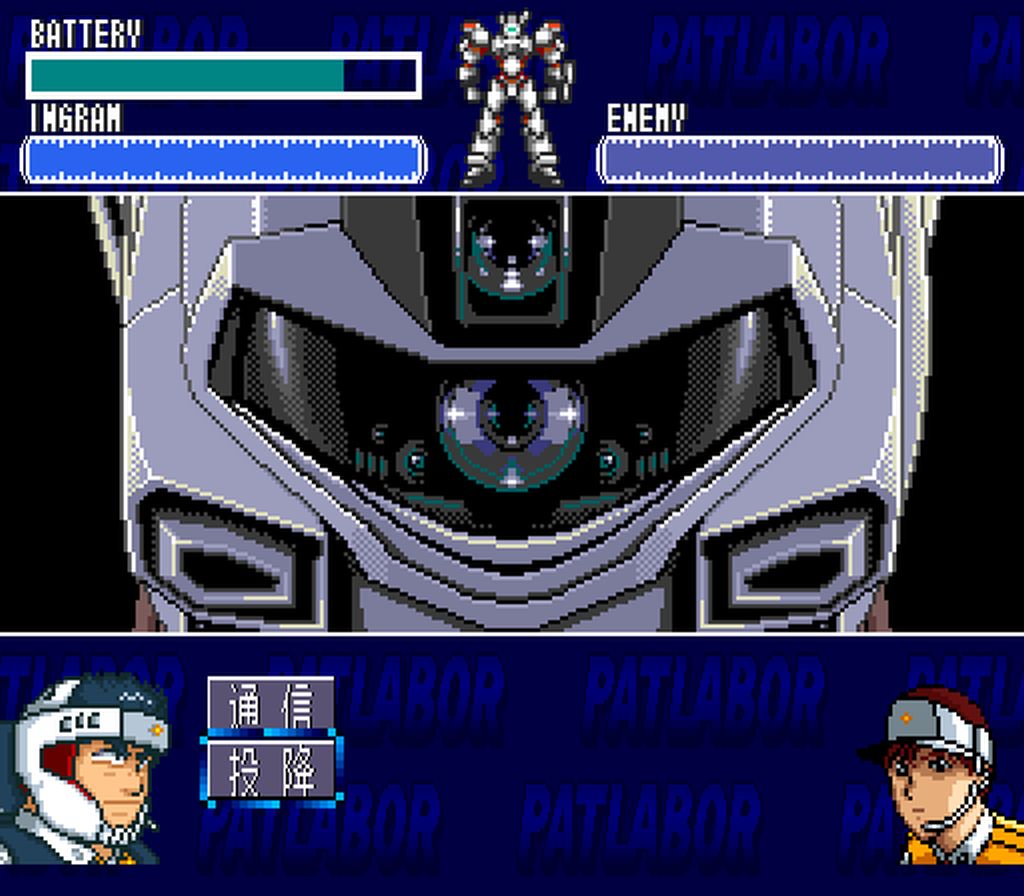
The battle system here is more formulaic than the Game Boy game. You select a command per turn, and see the results based on a dice roll. The main difference is the amount of commands available now, and the way you initiate battle. You now have to initiate battle every time you attack an opponent. There's no "being locked into a battle" here. While in the map, there's a bar on top of the screen (MVS, the patrol lights) that signifies your "readiness". Once this bar is filled up, you can walk up to the enemy and initiate an attack. Push A, the game asks you to specify a target. Once you confirm it, you initiate the attack.


Here's what sets Patlabor apart from other games. Once the action you chose finishes, you're booted back into the map screen. You have to wait for the MVS bar to fill up again to initiate another attack. Seems easy, right? Well, there's more to it than that. The enemy can also initiate an attack on you! So you have to balance approaching and staying away from the enemy, or you'll end up eating tons of attacks. There's no way to completely avoid being attacked, but try to stay away from the enemy as much as possible. One last thing is the Battery meter: it's sort of a time limit. It drains constantly, and initiating attacks or defending also drains it (stronger actions drain more of the bar). To recharge your battery, you must have the Ingram approach the Labor carrier (the big truck in the screenshot above).


Now, for the battle screen. It's a little overwhelming at first, but you'll get the hang of it pretty fast. There are two versions of this screen: one for attacking and another for defending. The attack options are as follows:
- Melee: those attacks are usually the weakest, but they have a very good chance to hit, and drain the least Battery.
- Special: attack with the baton or with guns. Lower chance to hit.
- Combo: this depends on the stage. Usually you'll get combos of moves, once you level up enough. Combos have a lower chance of success than almost every other attack. On the stage with the pigs, you use this to catch the pigs.
- Talk: you need to use this to finish some stages, but it has usually no effect on enemies still on fighting condition. When an enemy is greyed out, you can talk to them to get them to surrender.


The defense options are:
- Evade: completely evade an attack. Lower chance of success than Guard.
- Guard: receive less damage. Higher chance of success than Evade.
- Counter: not available at first, but counters a melee attack with 100% success.

Some notes: Even Guard has a chance to fail completely. Counter works 100% of the time to nullify the enemy attack, but your follow-up attack can still fail. To get Counter, you need to get all the 8 moves for both Melee and Special. 

Lastly, if you take too long at the Defense screen, the enemy goes through with its attack. You can take as long as you want on the Attack screen, and even cancel it to choose another target.


There's also the matter of range. You can initiate an attack from either long or short distance. If you choose short distance, all the options will be available. If you initiate from long distance, you can only use guns to attack. Even Talk will fail. All enemies will only attack you from short range, with a single exception, the final boss. When you push A to initiate an attack, the game stops for a second and lets you choose targets, even if only one target is available.


For the game itself. It is mission-based, and each mission is a "File", like in the TV Series. Finish the mission, close the file. The missions tend to be rather short, and are usually "destroy everything", like Second Division always does. There are story cutscenes between missions. There's also an intermission menu, you don't just go from one mission to the other. This is another interesting part of the system. Your Ingrams (Unit 01 and 02) can level up in 4 statistics, and you can train those statistics here. Level ups are done by doing the same action over and over. The 4 statistics are: Strength, Cle, Jud and Mobility. Strength governs melee and health. Cle governs special weapons, and Mobility helps in dice rolls, and also your speed while in the map. Also the MVS bar seems to fill up faster. I have no idea what Jud does. Judgement? Judo? 


The intermission menu is as follows:


Option 1: Mission
1a - launch
1b - sound (stereo/mono)

Option 2: Hangar
2a - train
2b - see available moves

Option 3: Save
There are three slots to save on.

1a and 1b are self-explanatory. 2a is very interesting. You choose either of the Ingrams, and you train against the other pilot. It is necessary to train both pilots, because neither of the Ingrams is available on all missions. I thought that if an Ingram went on a mission, it couldn't go on a mission right after it, but sometimes it could. So I don't know the reason that sometimes Unit 01 or 02 isn't available. Just have both of them ready. You can train indefinitely here, and you don't even need to exit the training once you defeat the other pilot. Goto will ask if you want to continue training. If you choose Yes, you go right back to it. Infinite grinding, yay. This isn't to say the game is easier because of this - the final stages are pretty hard, even with every stat at 99.


Now, the missions. Usually you just punch everything, but most missions have a small gimmick. Sometimes you have to convince someone to give up, like in Mission 2. There will be a lengthy conversation with the Labor pilot, and if you choose the wrong option, it's game over. Good thing that's the only mission where it happens. In another mission, you have to stop three rampaging Labors before they destroy a house. In another, you have to grab runaway pigs. In yet another mission, you need to fight in a horse track, and must be careful to not step on the horses. But usually, you just punch stuff. If the stage doesn't end there, you go up to the disabled enemy and talk to them, and they'll usually give up.


I didn't notice any gameplay differences between Noa and Ohta. They seem to have the same normal attacks, and even the combos are the same. The backup officer also changes (Asuma for Noa and Kumagami for Ohta), but this only changes dialogue in stages. Still, you can say there are 2 versions of every stage, since Asuma and Kumagami give different advice on dealing with the present threat.


I didn't expect much out of this game, and was quite surprised how much fun it is once you get the hang of it. The art is a huge plus, it's really gorgeous. The battle scenes also don't take too long, usually 1 or 2 seconds each. The only thing I didn't like was how you do so little damage with attacks, even with 99 on all stats. It takes between 5 to 15 attacks to take down a single Labor. Combos take them down faster, but are prone to missing. One thing of note is that the dice rolls on every hit of a combo, not just the first. So if a combo has 5 hits, you can miss on any of them, and the combo is interrupted.

The game has a few subsystems, but one that will usually be ignored is limb damage. When you enter battle, you can see your Ingram's condition at the top-center of the screen. If you take too much of a type of damage (punch, hammer punch), certain parts will start to deteriorate, first flashing yellow, then finally becoming disabled. Once the part is disabled, any attack done with that part is disabled. If your right arm is disabled, you can't punch, and so on. However, this is pretty hard to come by, and I only got this consistently during training matches (Ingram vs Ingram). I don't know if the same applies to the enemies, since you can't see their condition onscreen. A few moves seem to target specific parts, but without confirmation, there's no way to know if enemy parts can also get damaged. Immobilize Target, for example, targets one of the enemy's arms.


The Labor variety is pretty good. You'll usually fight most of the Labors that appeared in the TV series. The final boss is an original, called Gustaf. The pilot is an old acquaintance of Noa, a woman called Sumika, and the Gustaf is the only Labor in the game that uses a gun. Sadly, there's no Griffin. The enemies are all beautifully drawn too, even though they don't have as many poses as the Ingrams. On the player side, you only get the two Ingrams. No Type 0 this time.


The game has 21 missions and 2 endings, one for each pilot. Before Mission 18 is the last time you can use the intermission menu. On Mission 18, the pilot you choose will fight the final boss. Missions 19 and 20 are the same for both endings, just the pilots are switched around. The situation is that there is an explosion on the bridge you're standing on, and both teams are separated.


Well, to wrap this up. The game isn't what you'd call hard. Since you can just grind endlessly, and Counter works 100% of the time, you can't really lose to anything once you get it (save for running out of battery). Save for a few stages where you may need to be careful where you're stepping, the only hard parts are a stage in a dark cave, where you need to finish it in one go (no recharging on the Labor carrier), and the final stage, where the final boss uses a gun that does in almost 1/3 of your lifebar in a single attack. You can remedy the latter by staying near the final boss and just countering until you need to recharge. The former is just a question of memorization.

There's no English translation. But if you're in a Patlabor frenzy, you'll want to play this game at least once.


Can you play this without knowing Japanese?
Except for Mission 2, you can brute-force the rest of the game. You'll get a few Game Overs the first time because you won't know the failure condition, though.

Option translations:


All translations are from left to right.


Melee, Weapon, Special, Talk.


Punch, Kick, Tackle, Elbow, Lariat, Hammer Punch, Dropkick, Judo Throw.


Baton smash, Riot Cannon (Revolver), Baton thrust, Leg sweep, Wire, Baton crush, Riot Gun (Shotgun), Immobilize target.


Combos. They're strings of moves put together.


Talk.